|
RIPSTER REVIVALS #20
An irritatingly frequent ‘occasional’ column of ramblings around the world of (mostly)crime fiction and thrillers which begs the question: what’s the difference between Ripster Revivals and the Getting Away With Murder column he used to churn out? Answer: there is none, but the good news is that the new format is one year old this month and nobody seems to have noticed.
|
Venice Noirish
I attended the Venice Noir festival of crime writing with some (but not much) trepidation as most events were to be held in the historic cultural centre, the Ateneo Veneto, which was said to be difficult to find even though it is next door to the famous theatre La Fenice – very aptly named for somewhere that burned down a lot. I had however been supplied with an excellent map by British organiser David Hewson, through truth be told he could have said ‘Turn left at Prada, straight on past Bulgari and Max Mara, right at Gucci then left at Versace etc.’ or similar.
My first thought on arriving at the festival, as it always was when arriving at the late, lamented CrimeFest {other festivals are said to be available}was ‘where’s the bar and the drunk crime writers?’ Neither were in evidence, though over the week-end several were spotted through the windows of Venice’s many attractive bars and restaurants.
The highlight of the festival, which took place in equally impressive and historic surroundings (and there were two bars) was the presentation of the first Venice Noir award, a Murano glass dagger, to one of the festival’s main guests, Sir Ian Rankin.

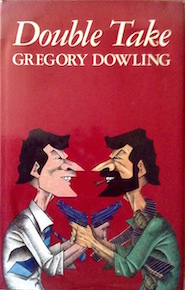
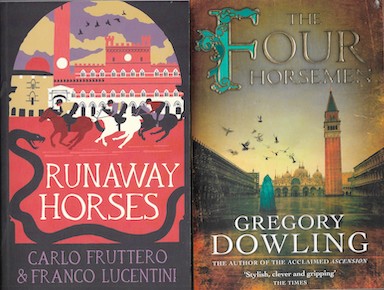
In the few hours allowed for socialising, it was a great pleasure to meet the charming Gregory Dowling, who lives in Venice, who informed me that we had both written books with the same title, Double Take, he in 1985 and me in 2002. He also told me how much he had enjoyed my ‘Angel’ novels and so taken aback was I by this, I entirely forgot to mention that I enjoyed his translation of Italian crime writers Fruttero & Lucentini and was looking forward to reading one of his own Venetian mysteries, The Four Horsemen.
Venice is, of course, a city of memories and during a splendid cocktail party in his honour, I managed to persuade Sir Ian Rankin to relive a memory of another city a long time ago and far, far away.
In 1992 or 1993 – the details are blurred by time – and when Ian was still a commoner and I had a proper job, I was in Edinburgh on business and Ian insisted on driving me around the city and showing me the sites, or at least the one sight I was really interested in, The Oxford Bar local of Inspector John Rebus. Naturally there had to be photographic proof of this event and Ian cheerfully agreed to recreate the scene 30+ years on in a bar in Venice.
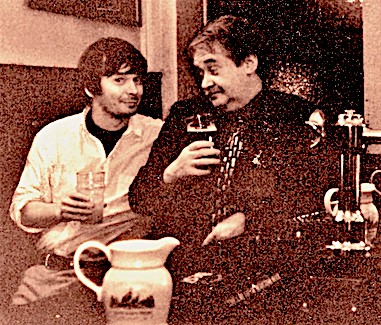

[NB: This is NOT this month’s Spot The Difference competition.]
London Noirish
Earlier than usual, this year’s Shots Christmas lunch was held in what seems to have become its traditional venue, Joe Allen’s showbiz eatery just off The Strand, where the staff gather eagerly to hear, once again, Ali Karim’s Royal Society of Chemistry lecture on the dangers of NaCl and where I, yet again, explain that the house red no-one else has ever heard of is Sicilian and really rather good.
The Four Horsemen of Shots, including Mike ‘Tombstone’ Stotter and the voluptuous Ayo Onatade, were joined by special guest Professor Barry Forshaw, but sadly our other regular guest, International Man of Mystery Peter Guttridge, cried off due to his ongoing compendium of medical misfortunes, as Proust might have said.
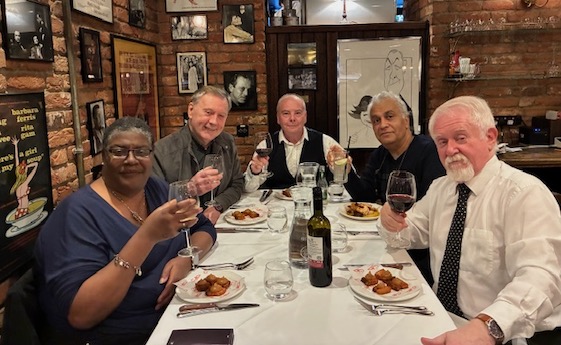
Although his sparkling wit was much missed (the tag-line on his paperbacks claiming he was ‘England’s funniest crime writer’ always made me chuckle), it did mean that the obligatory Sick Parade before lunch where everyone’s health is asked after (sometimes known as The Organ Recital) was reduced from five minutes to two.
A Promotional Approach to Christmas
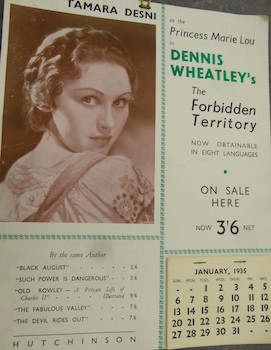 In my early days as an over-enthusiastic crime writer I would always include with the Christmas cards I sent, a flyer advertising my next book. One year I even used a shipment of paperbacks which had gone astray due to a strike in the publisher’s warehouse as Christmas cards and I still send cards, although the address list I use has tragically shrunk in recent years.
I suppose these days most authors rely on ‘social media’, whatever that is, but in the past some writers have shown great ingenuity in providing a Christmas/New Year reminder of their work to loyal readers.
Thanks to the indefatigable Charles Beck, the curator of the Dennis Wheatley website (www.denniswheatley.info/whatsnew.asp) I discover that the man once described as ‘The Prince of Thriller Writers’ sent out not only personalised Christmas cards, but also calendars which, for younger readers, were illustrated wall-hangings for those who did not own a smart phone.
Never one to miss a promotional opportunity, Wheatley illustrated his 1935 calendar with a still from the (then new) film of his first bestseller The Forbidden Territory as well as plugging his latest titles.
I am sure the calendar was a much appreciated gift at Christmas 1934, but I must admit I am unfamiliar with the career of German-born actress Tamara Desni and though I have read the book, I have never seen the film. It is said that Alfred Hitchcock was an early bidder for the film rights when the book came out and had he been successful, it would have made a cracking double bill with his version of The 39 Steps. [Would somebody please explain to younger readers what a Double Bill was.]
First XI
In my schooldays I was never picked for the First XI, though I have tried not to let it hold me back.

However I can now claim superiority over those flannelled fules on the cricket pitch as my Buried Above Ground has been acclaimed by Kirkus Reviews in the USA as one of the best (eleven) mysteries of 2025, putting me in the distinguished company of such as S.A. Cosby, Laura Lippman and Mick Herron.

The Elleston Phoenix
Having decided to release a Blu-Ray edition of their 1953 thriller Man In Hiding (aka Mantrap) in 2026, the famous Hammer Films decided that a selection of talking-head ‘experts’ would add value to the project by discussing the work of the author of the book on which the film was based. The novel in question was Queen In Danger, the second in a short series featuring chess-playing private eye Hugo Bishop, by ‘Simon Rattray’ – one of the many pen-names of Elleston Trevor.
Elleston Trevor itself was originally a pen-name of Trevor Dudley-Smith (1920-1995) and he liked it so much he changed his name legally, but it is under another of his writing identities that he is probably best known: Adam Hall, author of the ground-breaking spy novel The Quiller Memorandum.
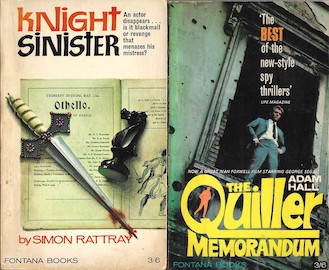
Trevor began his prolific writing career during WWII with a series of children’s and Young Adult tales, moving into the crime genre in the late 1940s. As Simon Rattray, he penned six novels featuring Hugo Bishop, all with a chess piece connection in the title, but the character was in some ways a throwback to the amateur detectives of the so-called ‘Golden Age’. Hugo Bishop was a man with a private income, no regular job, living in the poshest parts of London, employing a live-in personal assistant and driving a vintage Rolls-Royce. In looks he resembles the film star Leslie Howard, strolls around London with a cane and a pipe (always) on the go and is clearly attractive to women, but lives a bachelor life with a pampered Siamese cat and a collection of antique chess sets. (All his adventures are played out like chess games.)
And of course Bishop has amazing contacts with the police, who seem perfectly happy to let him play detective and solve their cases for them. He was a character who could have been created by Margery Allingham after brushing up on Saint and Sherlock Holmes stories and later in the decade, John Creasey was to create similar freelance sleuth heroes in The Toff and The Baron.
By the mid-1950s, Trevor seems to have tired of both Hugo Bishop and the Rattray pen-name because, although a proven and prolific author already, he was about to hit the really big time. In 1955 and 1956 be produced bestselling war stories The Big Pick-Up and Killing Ground which established him (along with a third wartime novel about the RAF, Squadron Airborne) as one of the top four authors in the stable of publisher William Heinemann, alongside Nevil Shute, Georgette Heyer and Earl Stanley Gardner.
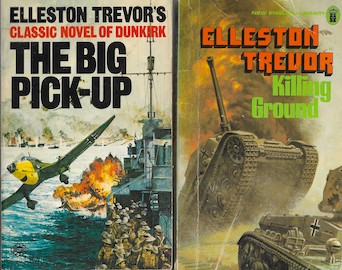
For The Big Pick-Up, Trevor is said to have advertised for survivors of Dunkirk to contact him and be interviewed in order to give realism to the dialogue of his group of isolated infantrymen desperately making their way to the evacuation beaches. The novel was used as one of the sources for Leslie Norman’s 1958 film Dunkirk and both book and film are excellent.
Perhaps even more impressive is Killing Ground, which follows the fortunes of a squadron of British tanks from their landing on Juno Beach on D-Day to the bloody battle for the Falaise Gap in Normandy. The early scenes of the actual landing are truly harrowing and as visceral as Spielberg’s depiction of Omaha Beach in Saving Private Ryan, and these war stories required Trevor to adopt a tougher, more muscular style, which he took to with enthusiasm in subsequent thrillers such as The Flight of the Phoenix and then refined it to the ‘nth’ degree, as Adam Hall, for his Quiller series of 19 novels which he wrote from 1965 to his death.
Elleston Trevor will be best remembered, and quite rightly, as Adam Hall for his Quiller novels, which introduced a new type of secret agent into the spy-fiction firmament; Quiller was no James Bond (a lone wolf who did not smoke, drink, use a gun or womanise) and he certainly was no George Smiley or ‘Harry Palmer’ although he did share Len Deighton’s (anonymous) hero’s distaste for authority.
Whether he will be remembered as Simon Rattray or the creator of Hugo Bishop, is another matter.
Do Mention The War (Again)
I mentioned in my last set of ramblings that my old pal Len Deighton had been on at me for ages to read Alexander Baron’s 1948 novel From The City From The Plough, which he praised as one of the best novels about soldiers in WWII.

Finally taking the hint, I treated myself to a Pan paperback first edition from 1953 and have to agree that Len was absolutely right.
It is the story of an infantry battalion, from senior officers down through NCOs to the lowest ranks, as they prepare for D-Day and how they react during their first experience of combat. There are good soldiers and bad, well-meaning officers and some nasty ones, diligent NCOs and cowardly ones. No individual heroes, but much heroism as the battalion buckles down and simply gets on with the deadly job they’ve been given.
Sad News from Umbria
A fabulous week-end at Venice Noir was spoiled by the news awaiting my return of the death of Michael Jacob, aged 77, at his home in Spoleto in Umbria.
Michael, although an unrepentant Scouser, had lived in Italy with his wife Daniela De Gregorio for more than forty years and formed that rarest of combinations, a husband-and-wife writing team as ‘Michael Gregorio’. Their first success was with a series of much-praised historical mysteries beginning with The Critique of Criminal Reason in 2006 and they later turned to contemporary Italian themes of corruption, organised crime and environmental threats.
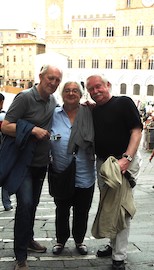
With Michael and Daniela in Siena.
On any visit to Italy, I always made contact with ‘The Michaels’ as I called them, who proved to be charming and generous hosts when they invited me to stay with them in Spoleto, and I know their hospitality extended to many other crime writers. Michael was an expert on vintage photography and a regular reader – and critic of – my Getting Away With Murder column in Shots.
Memories
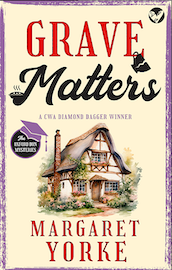
The news that Joffe Books is reissuing the early ‘Oxford Don’ crime novels of the formidable Margaret Yorke (1924-2012) reminded me of our last encounter, at the funeral of our friend and fellow crime-writer Harry Keating in 2011.
Paranoid about being late I arrived ridiculously early and settled in the otherwise empty Chapel of Rest, only to be joined by the also-early Margaret Yorke, with whom I had always got on well and whose novels I had reviewed favourably (for I did not dare do other) in the Daily Telegraph. We immediately started to set the world of crime writing to right and after half-an-hour noticed that other mourners had started to arrive.
Not caring who overheard, Margaret looked around and declaimed proudly: “You know, Mike, I will be the oldest person at this funeral.” At exactly that moment, a London black cab drew up at the entrance to the chapel and out stepped P. D. James.
“Bugger!” said Margaret loudly.
Recommended Revival
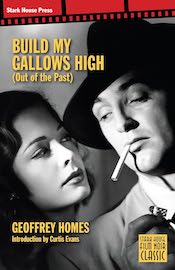 I have absolutely no reservations about recommending Stark House Press’ revival of that 1946 piece of classic ‘noir’ Build My Gallows High, which was filmed as Out of the Past by Jacques Tourneur, starring Robert Mitchum and Kirk Douglas
It was the last published novel of ‘Geoffrey Holmes’, the pen-name of mystery and screenplay writer Daniel Mainwaring (1902-1977). Both book and film were particular favourites of Philip Oakes, the journalist, poet, film critic and long-serving crime fiction critic for the Literary Review until his death in 2005.
As a reviewer, Philip was a staunch supporter of my ‘Angel’ comedies and my Crime File column in the Daily Telegraph, which resulted in us corresponding regularly over a period of about fifteen years. In the days before email (yes, I am that old) many of Philip’s letters were actually illustrated postcards, all of which, as far as I can recall, featured a still from the film Out of the Past. When I mentioned that I had seen the film on television, Philip insisted that I read the book Build My Gallows High on which it was based. As I had a new novel coming out which Philip would be reviewing, I did as Philip recommended – and if you have a taste for the noirish, you should to.
{And although not crime or mystery fiction in any way, for a fascinating memoir superbly written, I heartily recommend From Middle England by Philip Oakes.}
New Stuff on the Horizon
Although I am no longer at the cutting edge of the latest crime fiction (was I ever?), a few generous publishers do try and keep me ‘in the loop’ on new books coming in 2026.
I am already chomping at the bit at the news that there will be a new Martin von Bora thriller (in English) published by Bitter Lemon Press in March, The Little Fires by Ben (Verbena) Pastor. I say ‘new’ because I believe this was published in Italy some years ago and the English editions of the adventures of the aristocratic Wehrmacht officer turned reluctant detective have been, at times, chronologically challenged. Not that I’m complaining; I’m delighted to be able to read them in any order in English as my Italian is woeful in comparison to Ben Pastor who is bi-lingual.
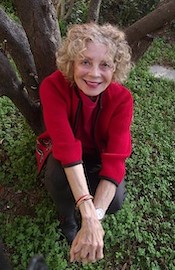
And here, I suppose, I must declare an interest in that Ben Pastor is not only a fellow archaeologist, but a very good friend of mine. But be that as it may, anyone suffering withdrawal symptoms from the fact that there will be no more Bernie Gunther books from the late Philip Kerr really should give Ben’s Martin von Bora novels a try. Her series – she writes in English but they are then translated for first publication in Italy – has been going for nearly twenty-five years now and are highly regarded in Europe. Bitter Lemon have done sterling work bringing them to a British readership and I hope they keep going as there are still more titles in Ben’s locker.
I have no wish to spare publisher Bitter Lemon’s blushes, and have certainly not been bribed or enticed by lavish hospitality on their part in recent years (just saying), but I must commend them for publishing the work of Joachim B. Schmidt, a Swiss author who emigrated to Iceland for the climate (he was mis-informed). His first two novels featured that most unlikely of detectives, Kalmann, solving mysteries – and most things are a mystery to Kalmann -which are at times incredibly funny, but also tragic and sad.
The new Joachim B. Schmidt novel, to be published in January, is something of a departure I think, as Òsman, the Ferryman of the North is set in 19th century Iceland and is already a bestseller in Switzerland and Germany.
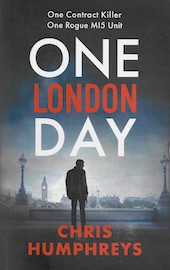
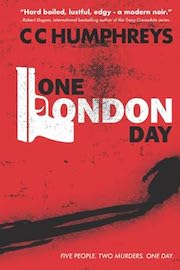
Also out in January, from Allison & Busby, is One London Day by Chris Humphreys, a noirish tale of skullduggery and criminality orchestrated by some disgustingly snobbish oiks and rogue MI5 agents.
I am intrigued by this new title as it reminds me of a thriller of the same title published in 2021 and written by a C.C. Humphreys, the author of many historical mysteries including the series featuring Jack Absolute, ‘the 007 of the 1770s’. Could this be the same book and the same author? I think we should be told.
Tackling more than just one violent day in the life of London in the era of Thatcherism, ‘poll tax’ riots, police corruption, illegal raves in Hackney and the Acid House craze (i.e. 1988-90) and doing so with more notes and references than a school history text book, is True Blue by Joe Thomas, published by Maclehose Press.
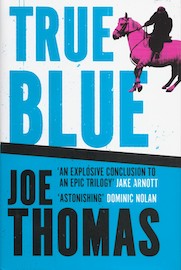
Unflinchingly political and frighteningly realistic, True Blue is the third part of Thomas’ United Kingdom trilogy, following on from White Riot and Red Menace. They all remind me of the Chinese curse ‘May you live in interesting times’ – because in this case I did.
Eagerly anticipated, at least in this household, is the return of Jack Parlabane, Scotland’s best journalist-turned-sleuth who cheerfully admits he would have failed the sensitivity training exam – probably got kicked off the course.
In Quite Ugly One Evening, which is of course by Christopher (now Chris apparently) Brookmyre and published in March by Abacus Books, Parlabane discovers, not for the first time, that blood is thicker than water and a lot messier even on a cruise liner full of ageing TV celebrities.
It will be, amazingly, thirty years since Jack Parlabane made his debut in Christopher’s (sic) debut novel Quite Ugly One Morning in 1996. It was the notorious year in which the Crime Writers’ Association decided, in its infinite wisdom, that there were no new crime novels worthy of being considered for the John Creasey Award for best debut. In less than twenty-four hours, a gang of rogue journalists (Parlabane would surely have approved) created The First Blood Award – the ultimate pop-up accolade – and had no trouble finding a short-list of six debut crime novels.
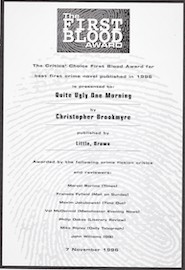
Guess who won.
And even deeper into next year, in May, the prolific, multi-talented American Lee Goldberg returns to ‘the light-hearted whodunit’ (he tells me) in Murder By Design published by Thomas & Mercer. Whilst mere mortals have to wait, I have been privileged to have been sent an early proof which I will tuck into along with my Christmas pudding.
Annual Round-Up
This is the time of the year when ‘Best of the Year’ lists emerge almost hourly. One American website dedicated to crime fiction recorded 25 different lists before I stopped counting, covering hundreds of books. (I must declare a personal interest in two of those lists. Well I don’t have to; just wanted to.)
I estimate that in 2025 I read only less than twenty percent of new titles compared to what I managed in my heyday, having been blissfully sidetracked by my attempts to scale the mountain of titles on my To-Be-Read pile. Of titles published in 2025, however, I am happy to point out, for what it’s worth, that the following gave me great pleasure this year: There Will Be Bodies by Lindsey Davis, A Schooling in Murder by Andrew Taylor, Blue Chalk, Red Blood, White Lightning by David Brierley, Smoke In Berlin by Oriana Ramunno and The Darkest Winter by Carlo Lucarelli.
In the spirit of full disclosure, I have to state that three of those books were written by good friends of mine and one is actually dedicated to me!
Have a good Christmas.
See you on the other side.
The Ripster.